si la matrice 16x16 Ghielmetti et le prestopatch sont le point de blocage pour beaucoup, pourquoi ne pas résoudre le problème en électronisant cette matrice et y ajouter des mémoires (et du midi pour édition à partir d'une tablette tactile) ?
suite à un post d'O-live dans un autre thread, voici les infos récupérées quant à la fabrication d'une matrice 16x16 (ou 32x32 si ça vous fait plaisir!) à base de AD75019.
Y aurait-il incompatibilité au niveau des caractéristiques des signaux du Synthi devant transiter dans cette matrice ?
ce qui existe déjà et peut être copié, Synapse DIGI-Matrix :
ce n'est plus commercialisé par Analogue Solutions, mais ils semblent ouverts à donner des infos :
The software to control the IC itself is simple to write. These ICs are available for those that have the technical know-how. We will not provide technical guidance.
Contact Analog Devices for application notes and support.
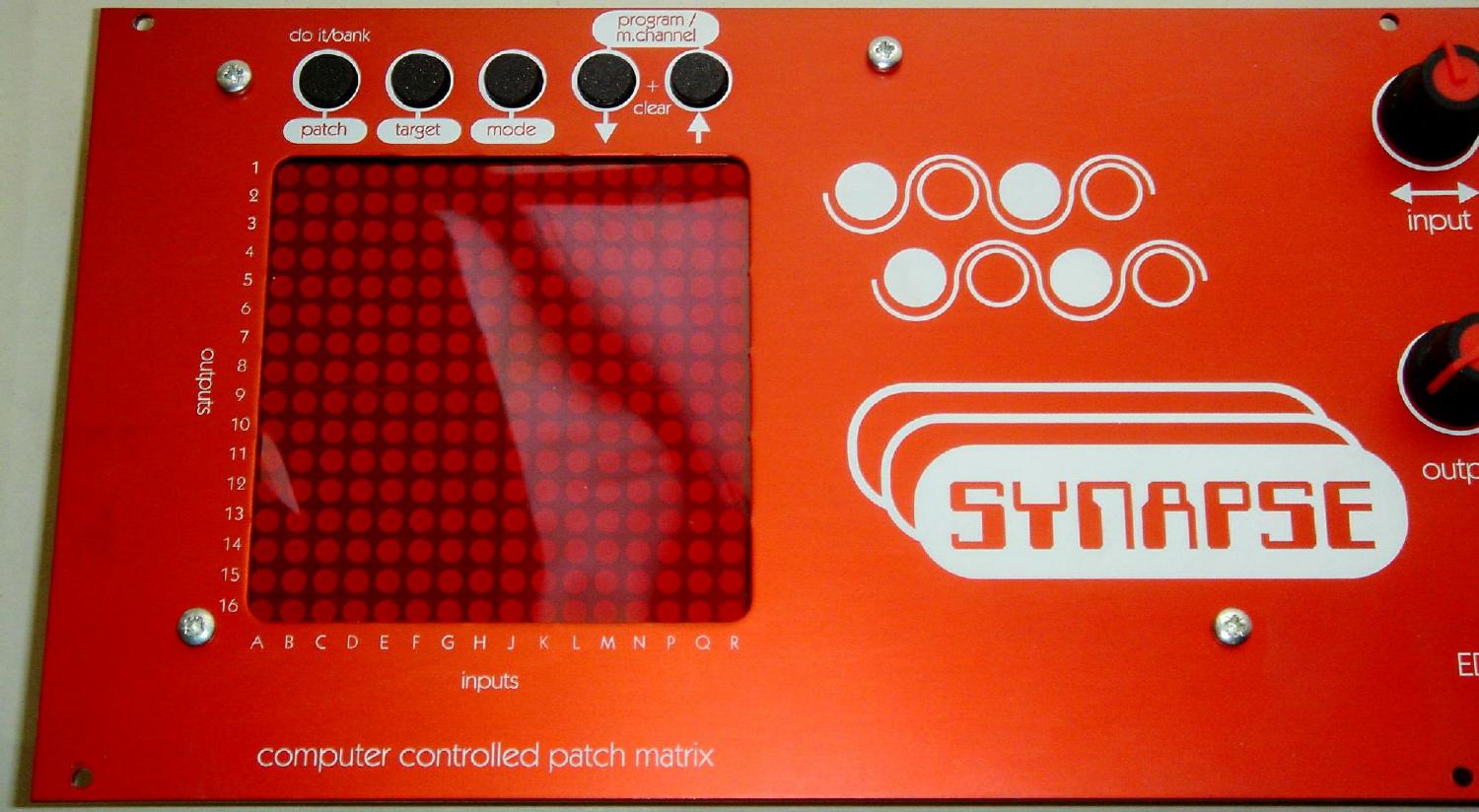
le manuel est ici :
http://www.cykong.com/Synths/AS%20Synap ... Manual.pdf
Je sais que certains membres d'anafrog "aspirent" des sites entiers. Quelqu'un aurait-il téléchargé à l'époque ceci (au cas où cela ne serait pas juste que la spec sheet) ?
'http://www.users.globalnet.co.uk/~concu ... 5019_16x16 switcher.zip'
http://www.cykong.com/Synths/AS%20Synap ... ynapse.htm
Synapse is fully buffered, but there are points to watch.
An input can be patched to multiple outputs with no cross talk, loss of level or side effects (signal splitting - 1 input to many outputs).
Multiple inputs can be patched to a single output, but the signals are not mixed 'ideally'. The performance is somewhere between an unbuffered matrix panel and an 'ideal' fully buffered matrix. It is possible that the signals may affect each other's levels slightly. The degree of which partly depends on the modules used and their electronic design. Generally for most patching this will not be a problem, but it may be noticeable for an output connected to a VCO pitch inputs. But, hey, there are no other digital controlled matrices!
le prix neuf etait de £350 inc.tax (en 2002) dans un boitier métal + alim. Le composant plus cher semble être le AD75019 (environ 20£).
http://web.archive.org/web/200310211812 ... /~concuss/
Les habitués du DIY devraient être capable d’approximer le cout de fabrication sans boitier, ni alim, ni jacks
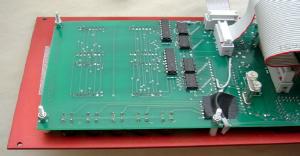
matrice :
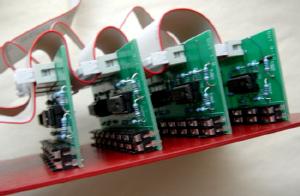
bufferisation :
 idées de version actualisée (contrôle par midi via tablette, style ipad) :
http://www.bohnes.de/e_matrix.html
idées de version actualisée (contrôle par midi via tablette, style ipad) :
http://www.bohnes.de/e_matrix.html
du Hinton clef en main (avec une mise en oeuvre plus onéreuse) :
http://www.hinton-instruments.co.uk/pap ... /index.htm
un projet :
http://synth.stromeko.net/DIY.html
Analog 32x32 Crosspoint Switch Matrix (untested!)
To check out the freeware version of Cadsoft Eagle, I've designed a 32x32 switch matrix based on the AD75019 16x16 crosspoint switch IC from Analog Devices. This version allows only two signal layers and a board size of half-Eurocard format (80mm x 100mm), which limited the board design quite a bit. Download this Eagle project ZIP 60k and unpack in your Eagle project folder. There's a few notes in the DESCRIPTION file in that folder that Eagle will display when you click on the project in the Control Center, if you don't have Eagle, simply load it into your web browser. The Board layout PDF 249k and the Schematics PDF 201k are seperately available (you don't need to download these if you have Eagle).
I've since re-thought the layout issues coming from the limitations of the Freeware version and how to actually build and assemble the thing. The result is a new board layout for just one switch matrix chip PDF 86k corresponding to these very simple schematics PDF 75k, the Eagle files are included in the project ZIP above. By using different pin headers, any number of these boards can then be combined to form various switch topologies. One of the motivations of doing a sub-board is of course that you can re-use them if you should later decide that you'd need a different configuration. Stay tuned for a 32x32 version using this board as a building block...
You would need at least a controller to feed the information on which switches are closed into the matrix to do anything with this. Some wires that hang off a serial or parallel port on a PC would be good enough for starters, I envisioned the matrix to be controlled via MIDI by something like a PIC and to be used as a cordless audio patch panel in front of my mixer. For synth audio/CV switching, you will probably want to add I/O buffering and programmable gain. Be aware that the shift register in those chips is dynamic, so there is a lower boundary to the clock for this operation. It would not be fun to inject 1024 bits with hand-operated switches anyway. If you (want to) do anything with this, please let me know.








 "min.struct" J'entends bien ta comparaison mais actuellement, cette mémorisation ne m'intéresse guère, n'est-ce pas superflus ?

 ).
). ).
). plus de sensibilité il y a plus le hp est performant sans demander trop d'amplification )
 )
)