
Analog synthesis
1. Sawtooth with CS-80-style “tooth”-impurity. Modulating the tooth width and polarity creates phasing and timbre animation.
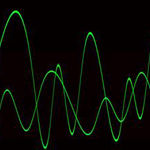
2. Continuous morphing through triangle, sawtooth, square and pulse waveshapes. With adjustable overdrive and coloration.
3. Sawtooth and square morphing. Continuous interpolation between the two shapes; and pulse-width modulation controls. Pulse-width modulation is applied to the sawtooth wave too, resulting in a thick “animated saw” sound.
4. Dual square wave with hard sync, with frequency ratio and balance control.
5. Triangle and sine, with continuous interpolation between the two shapes; and wave multiplier.
Direct digital synthesis
6. Band-limited dual pulse train, with bandwidth and detune controls.
7. Three ring-modulated sine waves, with detune controls.
8. Swarm of seven sawtooth waves, with detune and high-pass filtering controls.
9. Digital Sawtooth wave sent into a tuned delay line (comb filter) with positive and negative feedback.
10. Toy keyboard-like waveform generation, with waveshape and bitcrushing parameters.
11. 12. 13. 14. Direct digital emulation of triangle, sawtooth and square waves sent into low-pass, peaking, band-pass and high-pass filters (Casio CZ meets Roland D-50). Cutoff frequency and waveshaping controls.
Vocal synthesis
15. VOSIM synthesis with bell-shaped carrier; control over the frequency position of two formants.
16. 80s Home-computer vowel synthesis, with vowel and approximative chipmunk-approved vocal range control.
17. FOF vowel synthesis, with vowel and voice range (bass to soprano) control.
FM
18. 19. 20. Two-operators FM, with FM index and carrier/modulator ratio controls. Variants with rough feedback and chaotic behavior.
Simulations
21. Bell simulation, with absorption / inharmonicity controls.
22. 23. Plucked or bowed string simulation, with strength/pressure and geometry controls.
24. 25. Blown pipe / flute simulations, with pressure and geometry controls.
Wavetables
26. 256 waveforms distributed over 20 wavetables, with quantized wavetable selector, and smooth interpolation within a wavetable.
27. 256 waveforms optimally laid out in a 16×16 map, with smooth XY interpolation across the map.
Noise
28. Pitched noise source with state variable filter; Q and Oberheim-style filter mode (LP to notch to HP) controls.
29. Pitched noise source with dual bandpass filters; Q and separation controls.
30. Clocked noise, with adjustable cycle length, and adjustable quantization.
31. Granular cloud with density and dispersion parameters.
32. Particle system simulation (“bag of stuff”) with density and dispersion parameters.
33. Simulation of telecommunications digital modulator.

 Déjà un deuxième batch ?